
Travelling Hose Reel vs Center Pivot: Which Irrigation Pivot System Fits?
Short answer: choose the travelling hose reel irrigation machine (JP800, JP90-300 series) when the land is irregular, divided by obstacles, or has no reliable electricity supply — it is water-turbine driven, needs no electricity, and applies water through a DL50/SIMA10497 spray gun fed by a 300 m, 90 mm PE pipe at 0.6–0.9 MPa inlet pressure. Choose the fixed DYP center pivot irrigation system when one continuous block of 10, 30, 50 or 100 hectares can accept a permanent circular layout and a 380V–460V power supply. Field shape, power access and scale decide the machine; nozzle diameter, flow rate and steel specification follow from that decision.
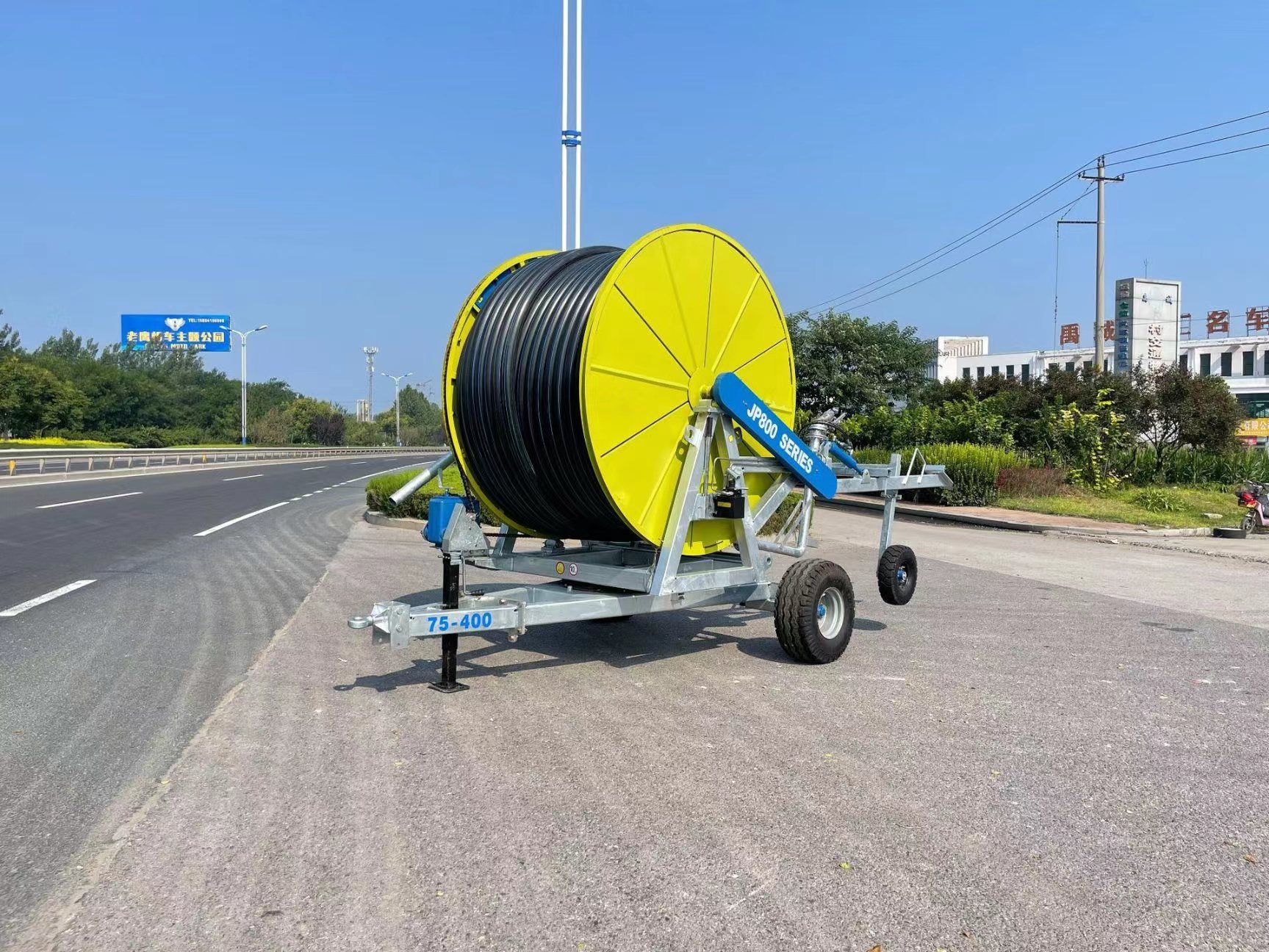
Two machine families dominate the shortlist for a single farm block. The travelling hose reel irrigation machine — also searched as traveler irrigation system or hose reel sprinkler irrigation — is a mobile unit that winches a polyethylene pipe across the field while a spray gun applies water. The center pivot irrigation system is a permanent, electrically driven truss structure that rotates around a central tower and irrigates a circle. Both configurations are manufactured by China Yulin Irrigation Equipment Co., Ltd., a Dalian-based irrigation machinery enterprise founded in 2009 that produces center pivot irrigation systems, lateral move irrigation systems, towing irrigation systems, hose reel irrigation systems, irrigation parts, matching water pumps and generators.
This guide compares the two configurations against the criteria that actually change a purchase decision: how the field is shaped, whether power reaches the field, and how much area one machine can serve.
Why Buyers Stall Between a Traveller and a Pivot
Most farm irrigation buyers do not struggle to find specifications. They struggle to translate those specifications into a layout decision. Three failure patterns appear repeatedly in procurement discussions.
Comparing unit prices instead of system boundaries. The hose reel price covers a machine that moves; the pivot price covers a structure that stays and rotates. They are not the same object, so a direct price comparison without a site plan is not meaningful.
Leaving power access until after the order. A fixed DYP center pivot uses an electromechanical, reversible drive on each span and operates at 380V–460V. Where no connection exists, a generator set becomes part of the project. A hose reel machine removes that dependency because the turbine is driven by the water passing through it.
Ignoring field geometry. A pivot irrigates a circle. The land usage coefficient within the irrigated circle is stated as not less than 0.9, which means the corners of a square field fall outside the wetted area unless an end gun or supplementary equipment is added. A hose reel irrigates a rectangular strip that can be laid along an irregular boundary.
The rest of this guide converts those three issues into a repeatable evaluation.
Market Context: Why This Decision Now Reaches More Buyers
The global center pivot irrigation system market was estimated at USD 2.56 billion in 2025 and is projected to reach USD 5.67 billion by 2030, according to Mordor Intelligence. That expansion is not evenly distributed. Lindsay Corporation secured a multi-year supply agreement for Zimmatic irrigation systems in the MENA region valued at more than USD 100 million in 2024, while Valmont Industries reported agriculture segment sales of USD 278.0 million in Q4 2024, representing 26.7% of total net sales.
On the technical side, ISO 11545:2009 remains the active international standard for determining the uniformity of water distribution from centre-pivot and moving lateral irrigation machines. In practice this means uniformity claims from either machine family can be tested in the field against a defined international method, rather than accepted on description alone.
For a buyer, the commercial implication is simple. Permanent pivots are being deployed in larger projects across more regions, including areas where power infrastructure is still developing. Those are exactly the conditions in which a water-turbine hose reel machine remains a rational alternative rather than a compromise.
Option A: Travelling Hose Reel Irrigation Machine (JP800, JP90-300 Series)
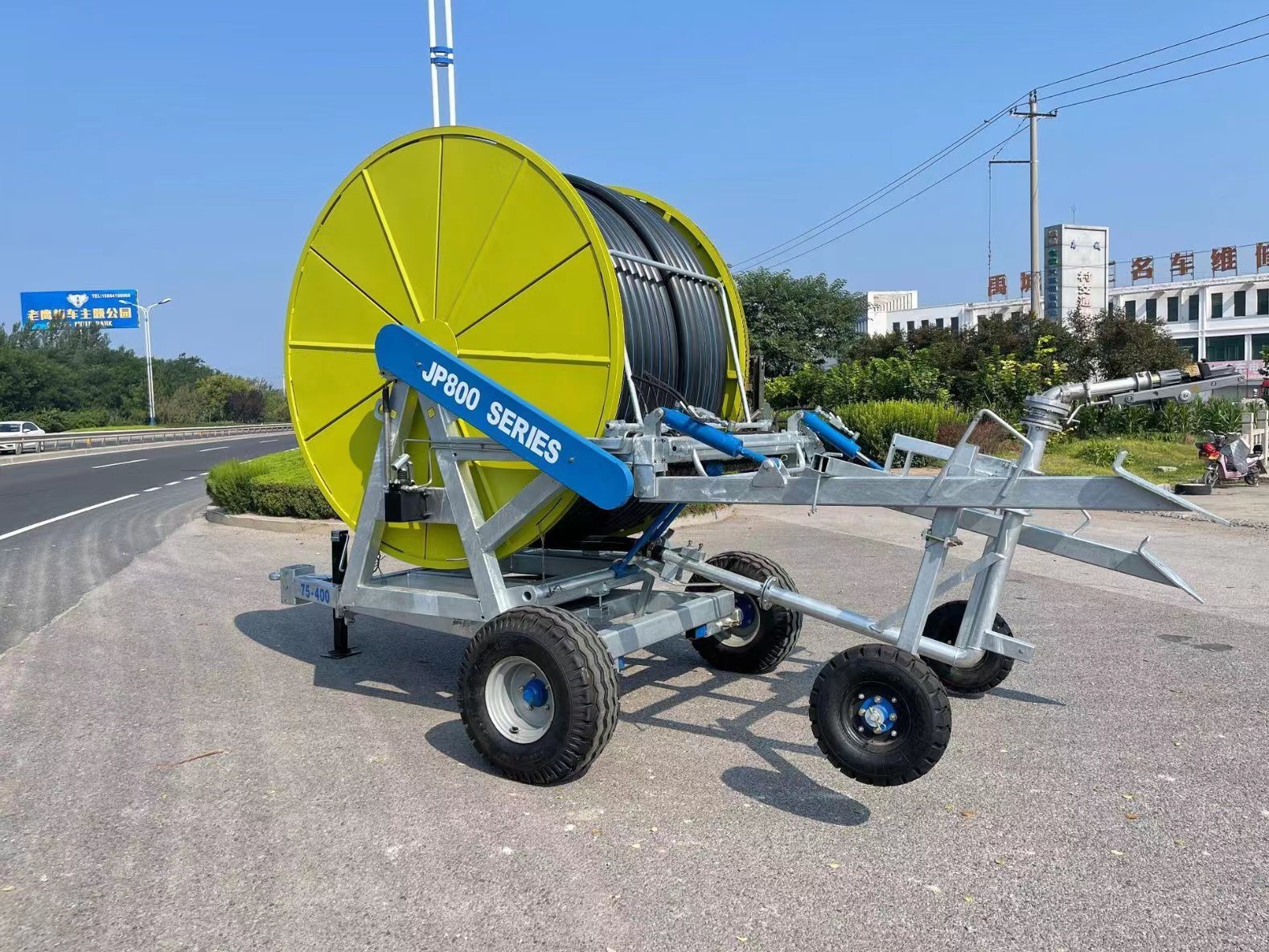
The JP800 is a hose reel irrigation machine in the JP90-300 series, driven by a water turbine rather than an electric motor. Because the drive energy comes from the irrigation water itself, the machine can operate on fields with no grid connection at all.
Confirmed specifications
- Model: JP800, part of the JP90-300 series
- PE pipe: 90 mm diameter, 300 m length
- Water flow: 25–52 t/h
- Nozzle diameter: 16–22 mm
- Spray gun: DL50 / SIMA10497
- Spray radius: 19–41 m
- Inlet pressure: 0.6–0.9 MPa
- Weight: 2,180 ± 30 kg
- Operating dimensions: 6,120 L × 2,330 W × 2,770 H mm
- Shipping dimensions: 2,450 L × 2,000 W × 2,250 H mm
- Construction materials: metal and PE
- Stated irrigation efficiency rating: 88% to 98%; stated service life: 25 years
Read as a planning strip, a 300 m pipe with a 19 m spray radius wets a band roughly 38 m wide; at the widest setting of 41 m, that band is roughly 82 m wide. That arithmetic is a starting point for strip spacing and pass planning, not a guarantee of application uniformity — overlap settings, wind and soil condition determine the final number, and uniformity itself can be verified using the ISO 11545:2009 method.
The operational consequence is mobility. Because the unit is quick and convenient to move and can be pulled from one block to another, one machine can serve several smaller parcels, rented land or a rotation schedule. The trade-off is that the pipe must be repositioned for every strip, so labour planning matters more than it does with a permanent pivot.
Option B: Fixed DYP Center Pivot Irrigation System
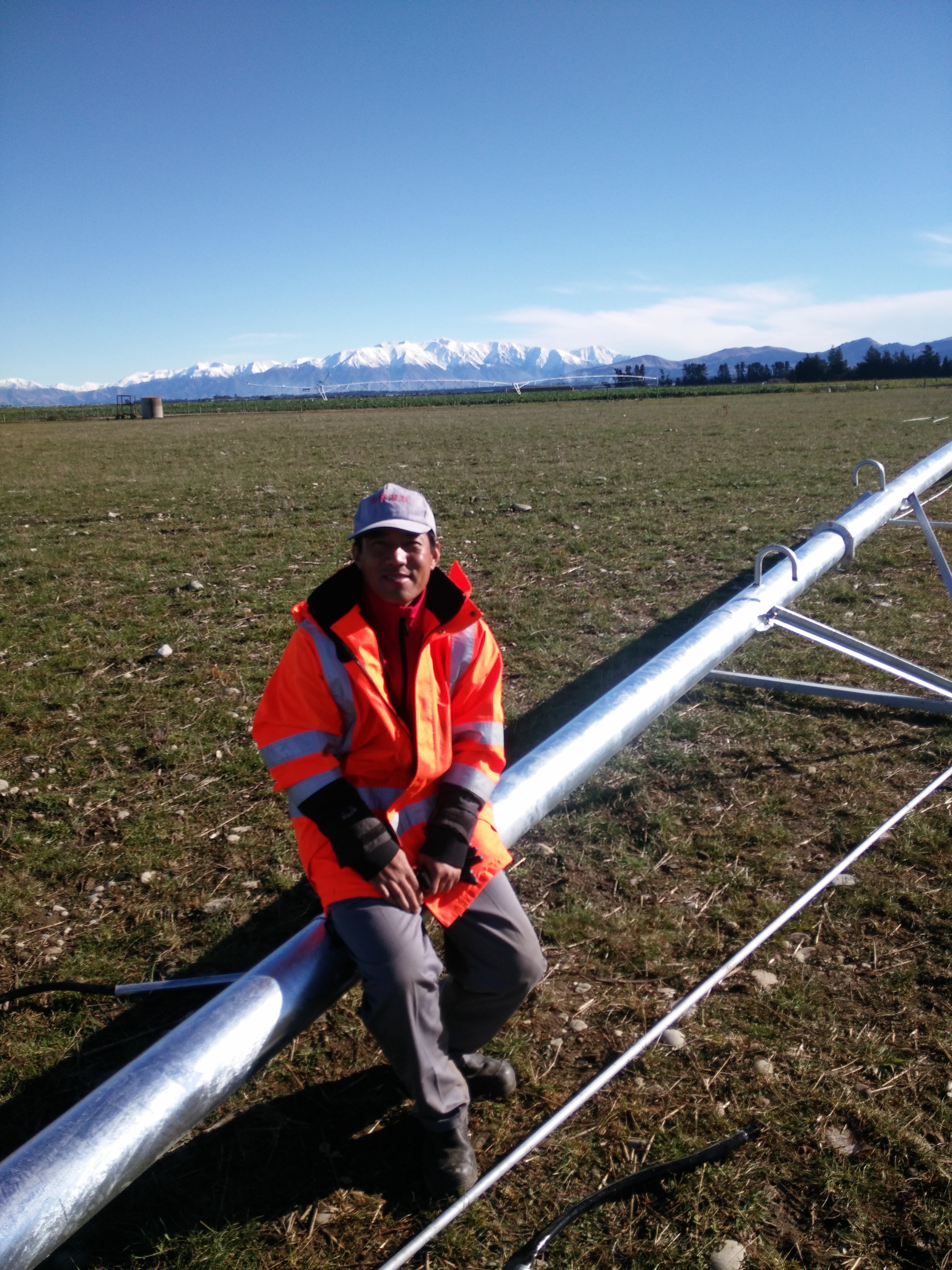
The fixed DYP center pivot is a permanent machine. It irrigates by circular motion in both clockwise and anti-clockwise directions, with a movement mode that is continuous with start-stop capability, and it is built in four size configurations matched to block area.
Size configurations
- 177.6 m long, covering 10 hectares
- 307.4 m long, covering 30 hectares
- 395.6 m long, covering 50 hectares
- 565 m long, covering 100 hectares
Confirmed technical specifications
- Pivot type: fixed DYP center pivot
- Drive: electromechanical, reversible, individual for each span
- Voltage: 380V–460V
- Control panel functions: main power switch (disconnect switch), power control switch, water switch, direction control switch, percentage indicator for speed regulation, auto-reverse switch
- Protection level: IP65
- Tower box protection: IP33; collector ring protection: IP65
- Distance from ground to bottom of truss rod: 3 ± 0.2 m
- Operating temperature: −45 to +45 °C
- Pressure regulators: 10, 15 or 20 psi
- Rain intensity: not more than 0.16 mm/min
- Average drop diameter: not more than 1.1 mm
- Plant mechanical damage: not more than 2%
- Land usage coefficient inside the irrigated circle: not less than 0.9
- Tower wheels: 14.9-24 irrigation tires, two wheels per trolley, hot-dip galvanized discs
- Water pipeline: sectional, truss structure
- Material: Q235B steel; product data references GB 13912-2020 for the steel material and GB/T 13912-2002 for the hot-dip galvanization coating
- Flexible irrigation hoses: PVC, reinforced, UV resistant
- Collector ring: 11 rings, not less than 4×90 A and 7×25 A
- Copper electrical cable core: not less than 4×4 mm² + 7×1.0 mm²
- Water quality: suitable for irrigation water with pH 6–7.5 during the warranty period
- Irrigated crops: fodder crops, cereals, vegetables and industrial crops, including corn
Two specifications matter most to a first-time pivot buyer. The 3 ± 0.2 m clearance under the truss determines which crops the machine can pass over, and the rain intensity ceiling of 0.16 mm/min determines how gently water is applied relative to soil infiltration rate.
The Three Criteria That Decide the Choice
1. Field shape and how the block is used
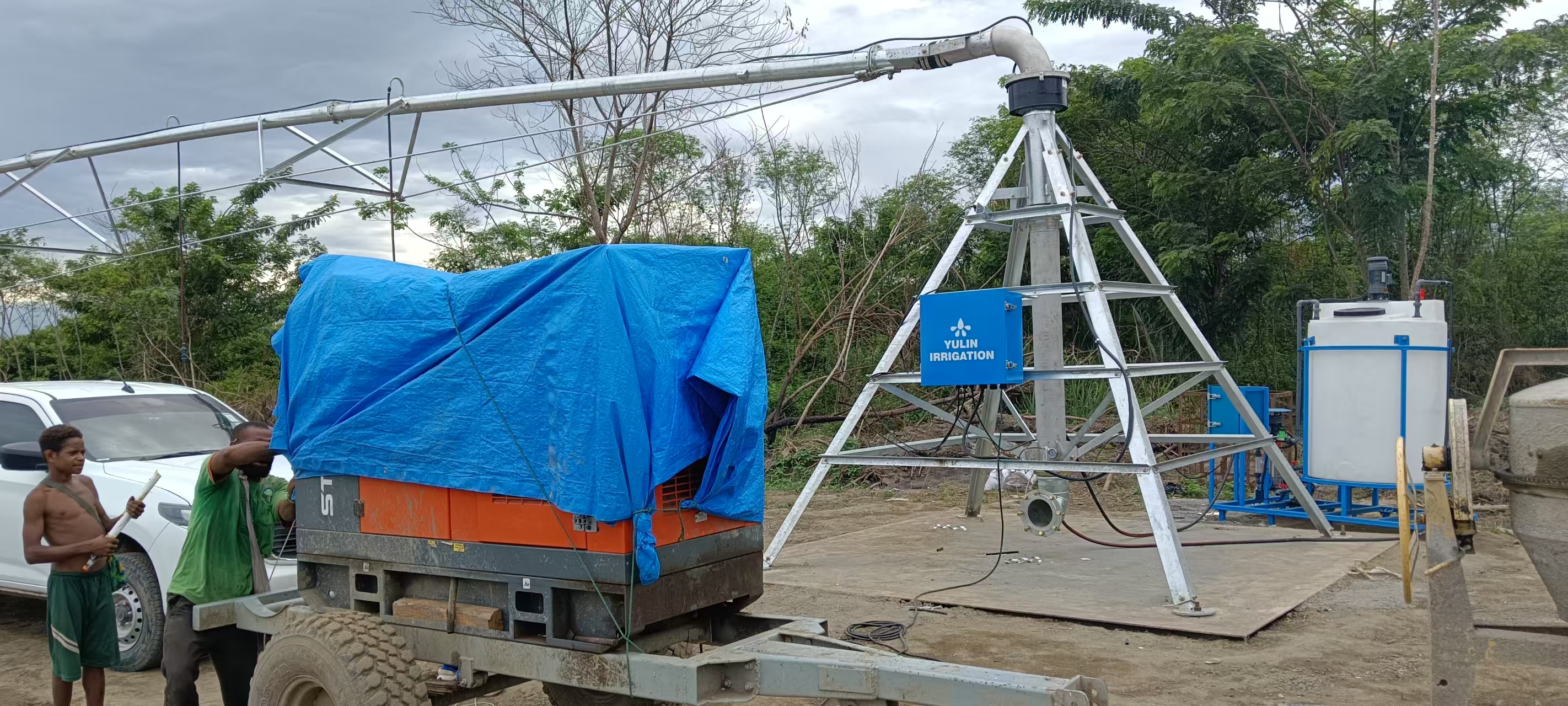
If the block is a single, uninterrupted square or rectangle large enough to contain a 177.6 m to 565 m circle, the pivot delivers the lowest labour input per hectare. If the block is L-shaped, cut by a road, a drainage channel, a power line or a stand of trees, the circle breaks down and the hose reel becomes the more practical tool. Corner coverage is also a decision point: in the Papua New Guinea dry-season project, the buyer specified an end spray gun specifically to provide supplementary irrigation for the corners.
2. Power access
The pivot requires 380V–460V and an electrical control panel with auto-reverse and speed regulation. The hose reel requires none of that — only water at 0.6–0.9 MPa inlet pressure and 25–52 t/h flow. Where the grid is absent or unstable, this single difference usually decides the purchase. In Papua New Guinea the system was driven by an independent diesel generator set precisely because the farmland had no reliable grid electricity.
3. Scale and water source
Scale works in the pivot's favour: one machine covers up to 100 hectares depending on the model selected. Scale works against the traveler only in labour terms, not in capability — a 300 m pipe and a 41 m spray radius still cover meaningful ground, but the machine must be repositioned between strips, so large areas require either more units or more operating hours. Water source sizing is the shared constraint: the pivot needs enough pressure at the hydrant to run regulators at 10, 15 or 20 psi, and the hose reel needs 25–52 t/h at 0.6–0.9 MPa through a 90 mm pipe.
Step-by-Step: Evaluating Both Options on Your Farm
- Draw the block and mark every obstacle. Mark buildings, trees, roads, channels and fence lines. If a circle of 177.6 m or more fits without crossing them, shortlist the pivot. If not, shortlist the hose reel and sketch the strip pattern.
- Audit the power supply. Confirm whether 380V–460V can reach the pivot point permanently and reliably. If not, price a generator set into the pivot option, or treat the water-turbine hose reel as the default.
- Measure water pressure and flow at the hydrant. For the hose reel, the target is 0.6–0.9 MPa inlet pressure and 25–52 t/h flow through a 90 mm PE pipe. For the pivot, confirm the pressure available at the machine after friction losses and set the regulators to 10, 15 or 20 psi accordingly. Also test water pH: the pivot specification covers irrigation water at pH 6–7.5 without quality problems during the warranty period.
- Convert scale into machines. For a continuous 50-hectare block, a 395.6 m pivot covers the area in one circle. For the same area in strips, calculate the number of passes from the wetted strip width, the pass length and the irrigation interval your crop requires. This step decides whether you are buying one pivot or several travelers.
- Verify compliance, manufacturing control and service. Check that the machine is covered by ISO9001:2015 certification, that at least 95% of spare parts are manufactured in-house for consistency, and that installation, commissioning and operator training are included. Confirm MOQ, lead time and test regime before releasing the order.
Farm Use Cases Behind These Two Configurations
The configurations are not theoretical. Documented projects show how buyers actually split between them.
- Brazil — soybean, hose reel: a large-scale farmer purchased 50 hose reel units for soybean irrigation and had used them for 6 years, reporting a 30% output increase in dry conditions alongside labour savings. The buyer highlighted that the machines were easy to pull from one land to another and easy to rent out.
- New Zealand — pasture, center pivot: a large-scale dairy farmer purchased 70 center pivot units for grass irrigation over 9 years, reporting increased crop output, labour savings and a long life span.
- Australia — forage and pasture, center pivot: a major distributor purchased 600 units used primarily for forage and pasture irrigation, and also for cotton and watermelon. Over 15 years the reported outcomes were energy savings of more than 40%, long life span and low maintenance cost.
- Zimbabwe — crops, towable pivot: 45 units used for crop irrigation over 6 years, with reported output increase and labour savings.
- Algeria — OEM channel supply: 70 units supplied over 7 years to a local brand, including whole-pivot support for local clients, with a reported 40% increase in efficiency.
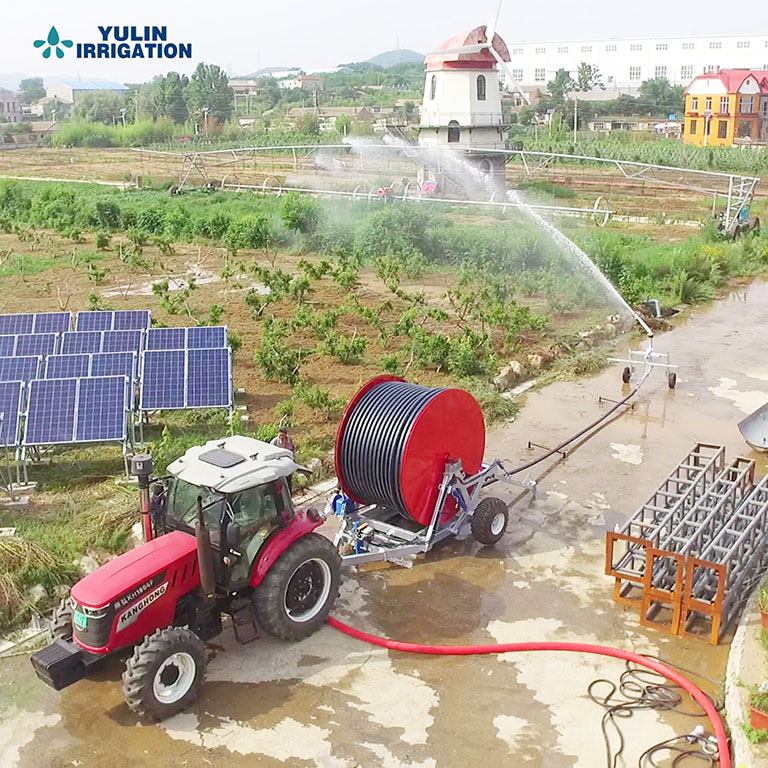
The pattern is consistent: hose reel machines cluster in soybean, rental and fragmented-land use, while pivots cluster in pasture, forage and consolidated blocks with permanent power.
Side-by-Side Comparison
| Decision factor | Travelling hose reel (JP800 / JP90-300) | Fixed DYP center pivot |
|---|---|---|
| Drive energy | Water turbine driven; no electricity required | Electromechanical, reversible, individual per span |
| Power supply | None at the machine; pumping pressure only | 380V–460V; IP65 control panel |
| Water requirement | 0.6–0.9 MPa inlet pressure; 25–52 t/h flow; 90 mm PE pipe | Regulators at 10, 15 or 20 psi; rain intensity not more than 0.16 mm/min |
| Application hardware | DL50/SIMA10497 spray gun; nozzle 16–22 mm; spray radius 19–41 m | Average drop diameter not more than 1.1 mm; plant mechanical damage not more than 2% |
| Coverage model | 300 m pipe length; wetted strip approximately 38–82 m wide depending on spray setting | 177.6 m / 10 ha; 307.4 m / 30 ha; 395.6 m / 50 ha; 565 m / 100 ha |
| Field geometry fit | Irregular blocks, obstacles, rented or split land | Continuous circles; land usage coefficient inside the circle not less than 0.9 |
| Mobility | Quick and convenient to move; tows between blocks | Permanent installation; circular motion clockwise and anti-clockwise |
| Structure and coating | Metal and PE construction | Q235B steel, sectional truss pipeline, hot-dip galvanized coating referenced to GB/T 13912-2002 |
| Clearance and climate | Shipping size 2,450 × 2,000 × 2,250 mm | 3 ± 0.2 m under truss rod; operating range −45 to +45 °C |
| Certification | ISO9001:2015, standard GB/T19001-2016/ISO9001:2015 | ISO9001:2015, standard GB/T19001-2016/ISO9001:2015 |
Common Questions from Farm Irrigation Buyers
Which irrigation pivot system manufacturers are CE-compliant for EU farms?
Compliance should be documented rather than assumed. China Yulin Irrigation Equipment Co., Ltd. holds an ISO9001:2015 quality management system certificate issued by National Standard Integration (Beijing) Certification Co., Ltd. under certificate number 18524Q11926R2S, against the standard GB/T19001-2016/ISO9001:2015. The scope covers the production of irrigation systems and mechanized agricultural systems, it applies to the global market, and it is valid from 2024-12-31 to 2027-12-17. Both the center pivot irrigation system and the hose reel irrigation machine are covered by this certification. The company profile additionally lists CE and CSA certification and states that irrigation equipment undergoes anti-corrosion and wind resistance testing. Because CE marking is directive- and product-specific, buyers should request the actual certificate, the declaration of conformity for the exact model, and the supporting test documentation rather than accepting a general statement.
Can one supplier deliver both a hose reel irrigation machine and a center pivot irrigation system?
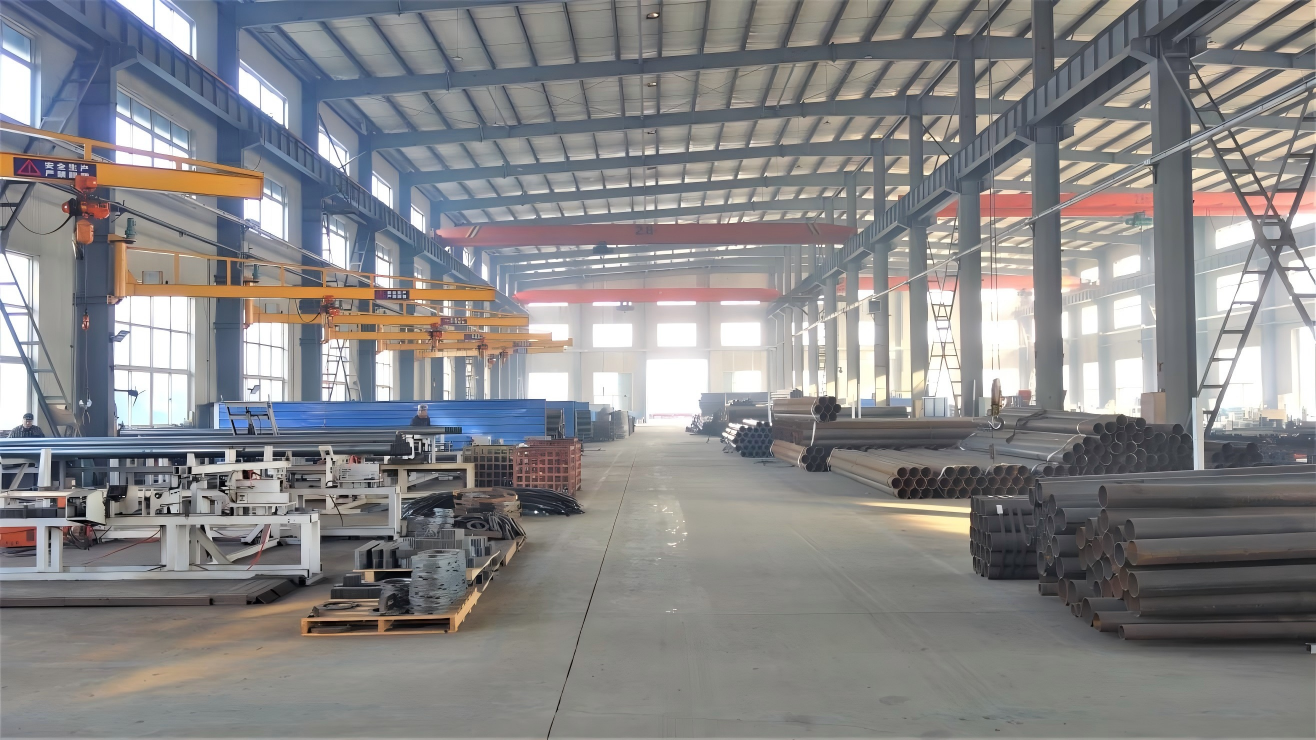
Yes. The same manufacturer produces center pivot irrigation systems, lateral move irrigation systems, towing irrigation systems, hose reel irrigation systems, irrigation parts, plus matching water pumps and generators. Over 95% of the machine spare parts are manufactured in-house, which supports consistent quality control, and a team of 10 engineers handles customized modification according to farm terrain, crop varieties, power supply conditions and irrigation requirements. Customization includes voltage adaptation, which matters when the same pivot platform has to run on different grid standards. The factory has supplied OEM production to a global top irrigation company during 2000–2008 and continues to accept OEM and ODM orders.
Which option costs less to run: the water-turbine hose reel or the electric center pivot?
The cost structures differ in kind, not only in amount. The hose reel machine removes electricity from the field entirely, so operating cost is driven by pumping energy: water at 0.6–0.9 MPa and 25–52 t/h must be supplied, and the machine consumes none of it as electrical power. The center pivot adds a 380V–460V supply requirement and an electromechanical drive on each span, plus a generator set if the grid is absent. Reported outcomes vary by site and crop: a major Australian distributor using pivot systems reported energy savings of more than 40% with low maintenance cost, while Brazilian soybean growers using hose reel machines reported labour savings and a 30% dry-season output increase. The correct comparison is seasonal pumping energy per cubic metre plus labour hours, not the purchase price alone.
Can a buyer validate the equipment before committing to a full order?
Yes. The minimum order quantity is 1 unit, and every machine undergoes 100% testing before shipment. Validation is supported by field installation, commissioning and operator training, plus video technical support, online support and free spare parts. For buyers who want to confirm configuration before scaling, the practical sequence is to start with a single unit, verify performance in the target field, and then expand — which is how several current fleet owners built up from one machine to dozens.
What is the lead time and how do I start a purchase enquiry?
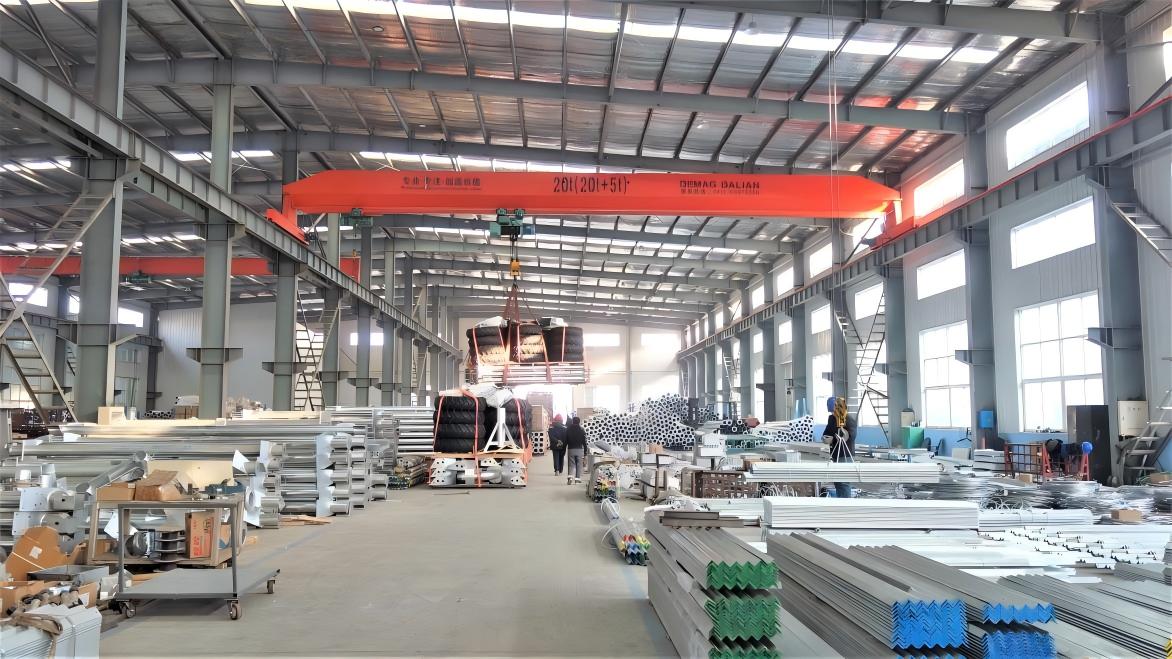
Production lead time is 21–40 days, with a monthly capacity of 60 units. The factory operates a 64,653 m² production site with 152 employees and an annual output of 3,000 units, and exports to the USA, Mexico, Europe, New Zealand, Canada, Australia, Africa and Egypt. To move from comparison to quotation, send your field size, field shape, water pressure and flow, available power supply, and target crop. You can download the full 2026 YULIN Pivot Catalogue (PDF) for specification reference, or contact Lara Yu directly with your site details to receive a configuration recommendation for either machine type.
Conclusion: Decide by Field, Then Confirm by Specification
The choice between a travelling hose reel irrigation machine and a fixed DYP center pivot is not a question of which technology is newer or larger. It is a question of fit. A continuous block of 10 to 100 hectares with permanent 380V–460V power belongs with a center pivot. A fragmented, rented or power-limited block where a 300 m PE pipe can be laid in strips belongs with a water-turbine hose reel machine.
Once the geometry and power question is settled, verify the specifics that protect the investment: the ISO9001:2015 certification with certificate number 18524Q11926R2S against GB/T19001-2016/ISO9001:2015, the Q235B steel and hot-dip galvanized structure on the pivot, the 90 mm, 300 m PE pipe and DL50/SIMA10497 spray gun on the hose reel, and the installation and training service that brings either machine into operation.
Next step: send your field layout for a fit assessment
Share your block size, field shape, water pressure and flow, and power availability. The engineering team will confirm whether a JP800 hose reel machine or a fixed DYP center pivot — 177.6 m, 307.4 m, 395.6 m or 565 m — matches your farm, and return a configuration with lead time and shipping plan.
Contact: Lara Yu | Email: yulinirrigation@hotmail.com | Tel / WhatsApp: +86 158-4249-7638
WhatsApp: Start a WhatsApp conversation
Website: www.cyulin.net | Catalogue: Download the 2026 YULIN Pivot Catalogue (PDF)
China Yulin Irrigation Equipment Co., Ltd. — 329-1 Shunle Street, Lvshunkou District, Dalian City, Liaoning Province, China.
Have Questions or Need More Details?
Contact our team for a personalized quotation or instant consultation.
Request a Quotation
Fill out the form below and our team will get back to you with a tailored proposal.
WhatsApp Direct Chat
Prefer to chat in real-time? Message us on WhatsApp for instant assistance & quick answers.
- Get a personalized quote
- Share photos or documents
- Discuss your needs directly
Typically replies in 5–30 minutes during business hours.