
Top 5 Irrigation Pivot System Models for Large-Scale Farming
A coverage-first ranking of five irrigation machines documented in Yulin Irrigation product data: four center pivot spans from 177.6 m to 565 m covering 10 to 100 hectares, each built as a Fixed DYP center pivot from Q235B metal conforming to GB 13912-2020, plus one travelling hose reel machine for the ground a circle cannot reach.
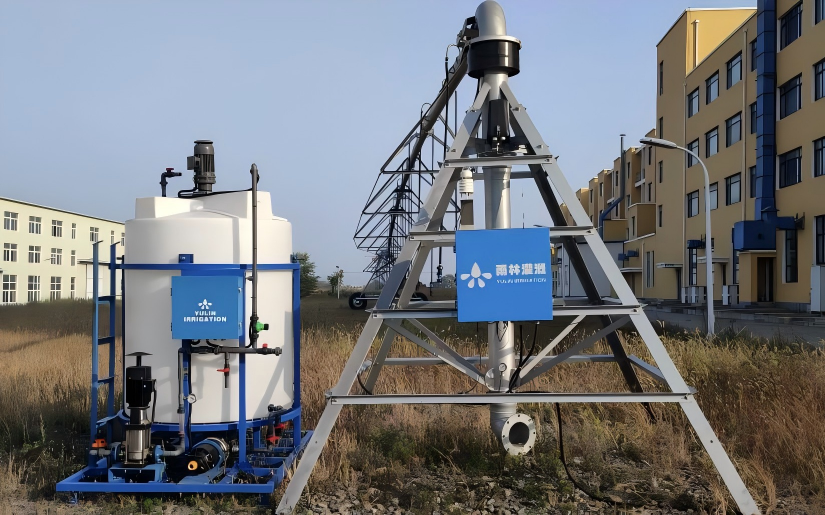
A fixed center pivot irrigation system combined with a fertilizer mixing tank — the configuration class ranked below is defined by span length and irrigated area.
Introduction: On a Large Farm, Hectares Decide the Machine
Above roughly ten hectares, the first specification that matters on an irrigation pivot system is not the colour of the control panel — it is the area the machine can actually irrigate. China Yulin Irrigation Equipment Co., Ltd. (YULIN IRRIGATION), a manufacturer established in 2009 in Lvshunkou District, Dalian, China, publishes four center pivot span configurations: 177.6 m covering 10 hectares, 307.4 m covering 30 hectares, 395.6 m covering 50 hectares, and 565 m covering 100 hectares. All four are built as Fixed DYP center pivot machines from Q235B metal conforming to GB 13912-2020, and all four share the same electromechanical, reversible drive architecture that is controlled individually for each span.
The fifth machine in this ranking is different in kind rather than in quality. The JP800 is a travelling hose reel irrigation machine — water-turbine driven, with no electricity required — and it is included because it sits inside the same documented product family, which also lists towable pivot irrigation machines, four-wheel linear irrigation machines and hose reel irrigation machines as machine types. Large farms in Australia, New Zealand, Canada, Mexico, Africa, Central Asia, Russia and Kazakhstan, the markets that absorb approximately 60% of Yulin's exported output, typically buy a pivot for the main block and a hose reel unit for the parcels the circle misses.
The order below is therefore deliberate: rank by irrigated area first, then by the structural and hydraulic evidence each configuration carries.
Problem Definition: Most Pivot Sizing Errors Happen Before the Quotation
Sizing failures on large farms rarely come from a badly built machine. They come from a machine that was selected against the wrong number — total farm area instead of the largest contiguous block that can accept a circle. Once the pivot is installed, four problems surface: unirrigated corners, runoff on heavy soils, mechanical damage where towers pass through a tall canopy, and corrosion in aggressive water. The published product data states the boundary for each of these, which is why they belong at the top of a ranking article rather than in a footnote.
- Land usage coefficient inside the irrigated circle (including the area near the center tower): not less than 0.9. A 565 m pivot irrigates 100 hectares, but the remaining corner land of a square field still needs an end gun, a hose reel machine, or dryland management.
- Rain intensity: not more than 0.16 mm/min. Application above the soil infiltration rate produces runoff and nutrient loss regardless of how even the machine is.
- Distance from the ground to the bottom of the truss rod: 3 ± 0.2 m — the clearance that decides whether a tall crop such as corn can grow under the span.
- Water quality: irrigation with water at pH 6–7.5 is documented as usable without quality problems during the warranty period; outside that band, pipe material becomes a procurement question, not a maintenance detail.
- Environment: the machines are documented for ambient temperatures from −45 to +45 °C, and Yulin states that its irrigation equipment undergoes anti-corrosion and wind-resistance testing to suit tropical, saline-alkali and high-wind farmland.
- Power supply: 380–460 V with an IP65 control panel; where the grid is unreliable, a diesel generator set is the documented alternative.
The honest first question is therefore not which pivot is the most powerful, but which span length fits the measured block and whether the site water, soil and power supply fall inside the documented operating envelope.
Industry Background: Capital Is Moving Into Large Blocks, Standards Are Tightening
Market estimates vary by scope, so the figures should be read with their definitions attached. Mordor Intelligence estimates the global center pivot irrigation system market at USD 2.56 billion in 2025 and projects USD 5.67 billion by 2030; some research houses publish noticeably higher totals because their definitions include full project construction rather than equipment alone. The direction of travel is consistent even where the number is not: large-block mechanised irrigation keeps expanding.
Contract activity shows where the volume is concentrated. Lindsay Corporation secured a multi-year supply agreement for Zimmatic irrigation systems in the Middle East and North Africa region valued at more than USD 100 million in 2024. Valmont Industries, whose agriculture segment includes Valley Irrigation, reported segment sales of USD 278.0 million in the fourth quarter of 2024, equal to 26.7% of total net sales. Both figures describe project and equipment scale rather than a single farm, but they confirm that multi-year, multi-machine orders are now normal in large-farm procurement — which raises the weight of supply continuity and after-sales support in the buying decision.
Standardisation is the third background factor. ISO 11545:2009 is the active international standard specifying the in-field method for determining the uniformity of water distribution from centre-pivot and moving lateral irrigation machines. Uniformity is measurable, and a buyer comparing the configurations below can ask for the test framework instead of accepting a descriptive claim.
On the manufacturing side, Yulin operates a facility covering 64,653 m² with approximately 152 staff, including an R&D team of 10 engineers, and produces about 3,000 units a year; the company's published supply page lists a capacity of 400 pivot sets per year. Around 60% of production is exported to Australia, New Zealand, Canada, Mexico, Africa, Central Asia, Russia and Kazakhstan.
Detailed Solution: The Five Configurations, Ranked by Coverage
All four pivot configurations share one platform, so the following specification applies to each of them. The pivot type is a Fixed DYP center pivot; the drive is electromechanical, reversible and controlled individually for every span; voltage is 380–460 V. The standard control panel provides a main power switch (disconnect switch), power control switch, water switch, direction control switch, a percentage indicator for speed regulation and an auto-reverse switch, rated IP65. Pivot movement matches the motor of the last tower and runs continuously or start-stop, with irrigation in circular motion both clockwise and anti-clockwise. Each tower trolley carries two 14.9-24 irrigating tires with hot-dip galvanized discs; the water pipeline is sectional with a truss structure; flexible hoses are PVC, reinforced and UV resistant. The collector ring has 11 rings, not less than 4×90 A and 7×25 A; protection is IP33 for the tower box and IP65 for the collector ring; copper cable core thickness is not less than 4×4 mm² + 7×1.0 mm². Pressure regulators are offered at 10, 15 or 20 psi, average drop diameter is not more than 1.1 mm, plant mechanical damage is stated at not more than 2%, and the documented crop range covers fodder crops, cereals, vegetables and industrial crops, including corn. Irrigation rate per 24 hours is listed as an option, meaning it is agreed with the order rather than fixed by the catalogue.
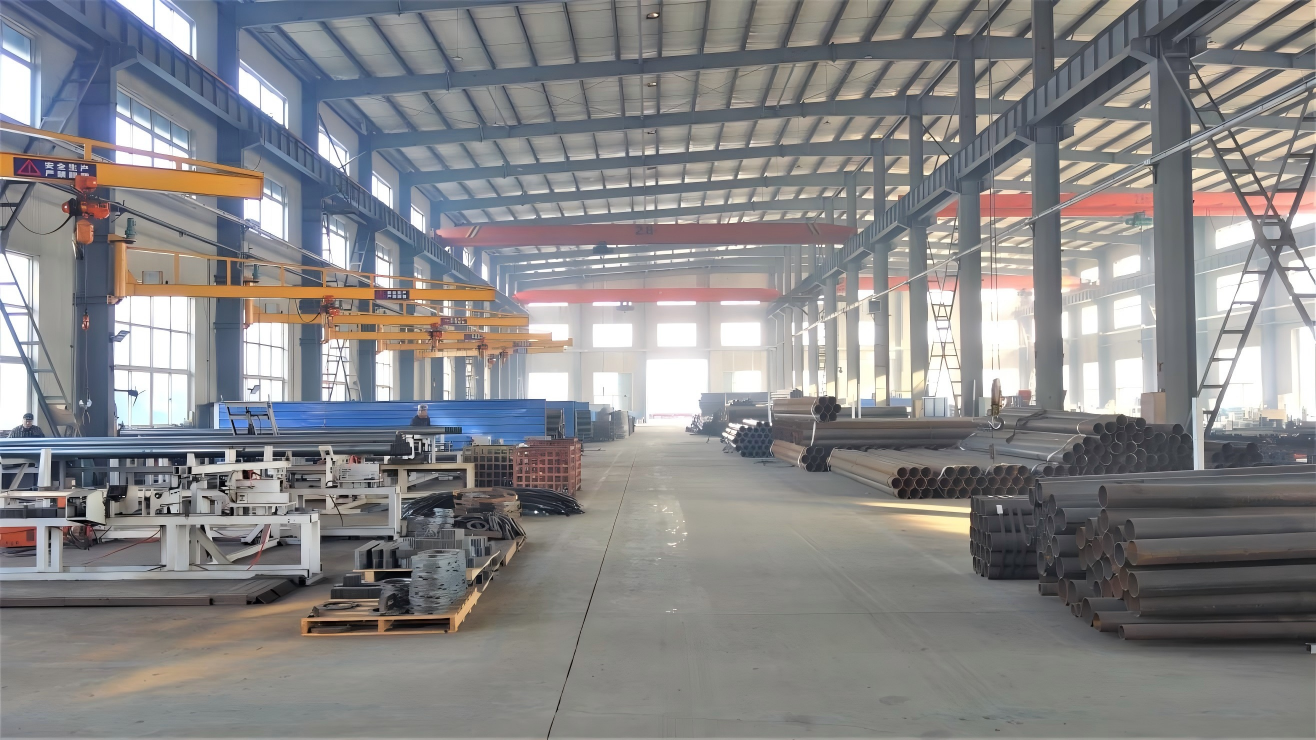
Tower cart and truss production inside the Yulin Irrigation workshop — over 95% of the machine spare parts are manufactured in-house.
Rank 1 — 565 m Span, 100 Hectares: The Full-Block Configuration
Coverage is the entire argument for this machine. A 565 m span irrigates 100 hectares in a single circle, which makes it the configuration for continuous cereal, fodder and industrial-crop blocks where the pivot behaves as permanent infrastructure rather than seasonal equipment. Two platform details matter more at this length than at any other. Because each span has its own reversible electromechanical drive, a long machine keeps the truss aligned when individual towers run at slightly different speeds; and because the truss underside sits 3 ± 0.2 m above the ground, a full 100-hectare corn block can be irrigated without the span touching the canopy. The documented land usage coefficient of not less than 0.9 inside the irrigated circle is also the number a 100-hectare buyer should budget against, since corner land remains outside the circle unless an end gun or a second machine is added.
Rank 2 — 395.6 m Span, 50 Hectares: The Most Field-Proven Configuration
The 50-hectare configuration is the span length with the clearest documented project record. A Yulin center pivot irrigation machine of 395.6 m covering 50 hectares was supplied to a farm project in Papua New Guinea, where irrigation substitutes for rainfall during the dry season so that plants can keep growing through the dry months. The order demonstrates how far a 50-hectare pivot can be configured: the machine was matched with an end spray gun for supplementary irrigation of the corners, an optional poly pipe to prevent acidic or alkaline water from corroding the pipes, and pesticide injection for integrated pest control during the irrigation pass, together with a 1,000 L fertilizer tank for simultaneous watering and fertigation. Because the site had no reliable grid supply, the system was driven by an independent diesel generator set.
Rank 3 — 307.4 m Span, 30 Hectares: The Rotation-Farm Configuration
Thirty hectares is the size at which a farm usually stops being a single-crop operation, and the 307.4 m span is the configuration that fits that shift. The documented crop range covers fodder crops, cereals, vegetables and industrial crops including corn, so the same machine serves a rotation programme without changing span length between seasons. It is also the practical step-up size for a farm that intends to run one pivot now and a second later: the electrical architecture, the IP65 panel and the 10, 15 or 20 psi regulator options are identical to the larger machines, so operating procedures carry across.
Rank 4 — 177.6 m Span, 10 Hectares: The Small Center Pivot
Ten hectares is the entry point of the range and the configuration most buyers search for as a small center pivot irrigation system. It keeps the full platform specification — Fixed DYP pivot type, per-span electromechanical drive, 380–460 V operation, 3 ± 0.2 m truss clearance, IP65 panel — and shrinks only the coverage. Typical fits are trial and seed-multiplication blocks, vegetable and fodder production close to the farmstead, and a second machine on a satellite parcel. On a block this size, buyers should also compare the fixed option against the other machine types listed in the same product family, namely towable pivot irrigation machines, four-wheel linear irrigation machines and hose reel irrigation machines, because a 10-hectare parcel that has to move seasonally is not automatically a fixed-pivot job.
Rank 5 — JP800 Travelling Hose Reel Irrigation Machine: The Non-Pivot Supplement
The JP800 is listed as a travelling hose reel irrigation machine belonging to the hose reel irrigation system category — it is not a center pivot, and it is ranked here because it addresses the ground that a fixed circle cannot. Documented specifications are a 90 mm PE pipe, 300 m pipe length, water flow of 25–52 T/H, nozzle diameter of 16–22 mm, spray radius of 19–41 m, inlet pressure of 0.6–0.9 MPa, weight of 2,180 ± 30 kg, outside dimensions of 6,120 L × 2,330 W × 2,770 H mm and shipping dimensions of 2,450 L × 2,000 W × 2,250 H mm, in metal and PE. The machine is water-turbine driven, so no electricity is required, which makes it usable on parcels where the grid never reached, and its documented operating profile emphasises simple operation, quick relocation, water and labour savings. For a large farm running any of the four pivots above, it is the option for corners, elongated parcels and fields outside the circle.
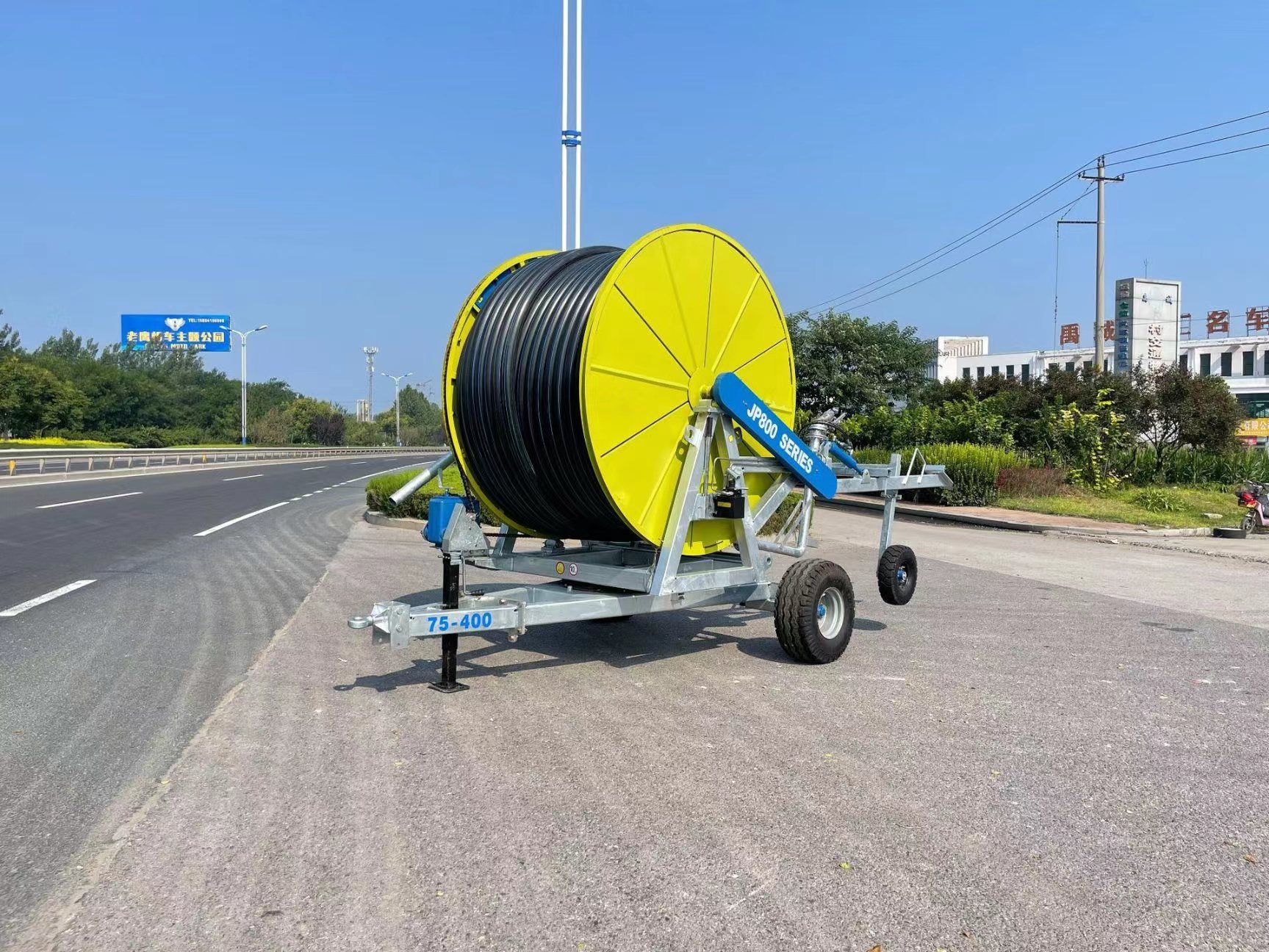
JP800 hose reel irrigation machine: 90 mm PE pipe, 300 m length, water-turbine driven with no electricity required.
Step-by-Step Breakdown: Matching a Configuration to a Measured Field
- Measure the block, not the farm. Identify the largest contiguous area that can accept a circular machine. Everything outside it is corner land or satellite land and should be planned separately.
- Convert hectares into span length. The documented pairs are 10 ha → 177.6 m, 30 ha → 307.4 m, 50 ha → 395.6 m and 100 ha → 565 m. Start from the span that matches the measured block, then confirm it against the crop plan.
- Check canopy clearance before lengthening the machine. The distance from the ground to the bottom of the truss rod is 3 ± 0.2 m. If corn or another tall industrial crop is planned, verify clearance rather than assuming it.
- Match the application rate to the soil. Documented maximum rain intensity is 0.16 mm/min. On heavy or compacted soils, choose the nozzle and regulator configuration (10, 15 or 20 psi) so that the application rate stays under the infiltration rate.
- Test the water. pH 6–7.5 is documented as usable during the warranty period. Outside that band, specify the poly pipe option used on the Papua New Guinea project, and confirm compatibility before order placement.
- Confirm the power supply. The machines run on 380–460 V with an IP65 control panel. Where the grid is absent or unstable, plan a diesel generator set as in the documented dry-season project.
- Decide how the corners will be handled. The documented options are an end spray gun on the pivot itself, a hose reel irrigation machine such as the JP800, or a movable machine from the towable pivot range.
- Validate the specification with the factory before shipping. Yulin provides flexible customized modification according to farm terrain, crop varieties, power supply conditions and personalized irrigation demands; more than 95% of the machine spare parts are manufactured in-house for process control, and global localized on-site installation, commissioning and operator training are provided overseas.
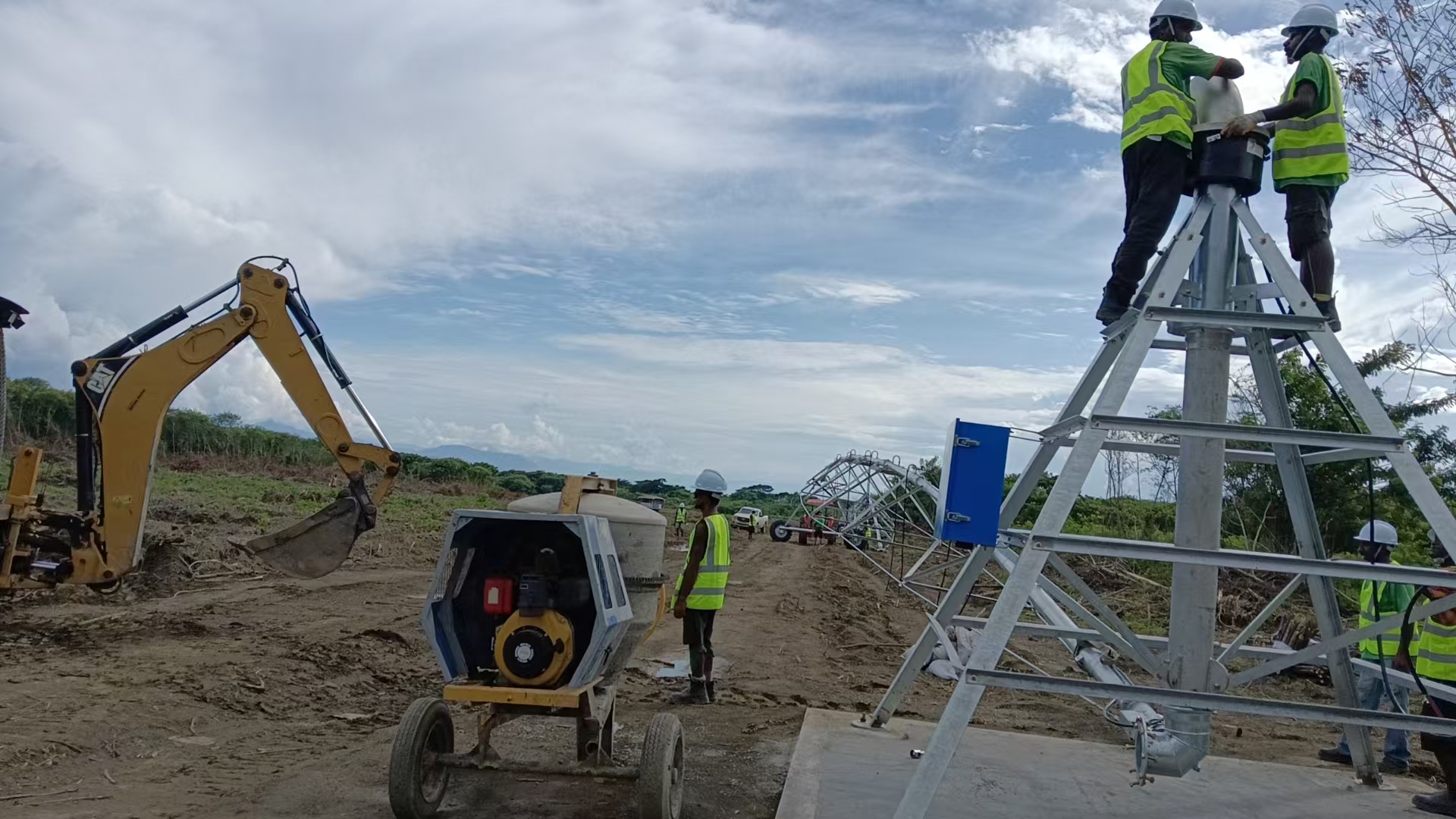
Yulin engineers supervising on-site assembly and commissioning at a client farm — the documented installation service model.
Use Cases: Where Each Configuration Has Been Applied
Dry-season production without a reliable grid — 395.6 m, 50 ha
In the Papua New Guinea project, the 395.6 m machine covering 50 hectares works as a substitute for rainfall during the dry season. The configuration combines an end spray gun for corner irrigation, optional poly pipe for aggressive water, pesticide injection during irrigation, a 1,000 L fertilizer tank, and an independent diesel generator set for power.
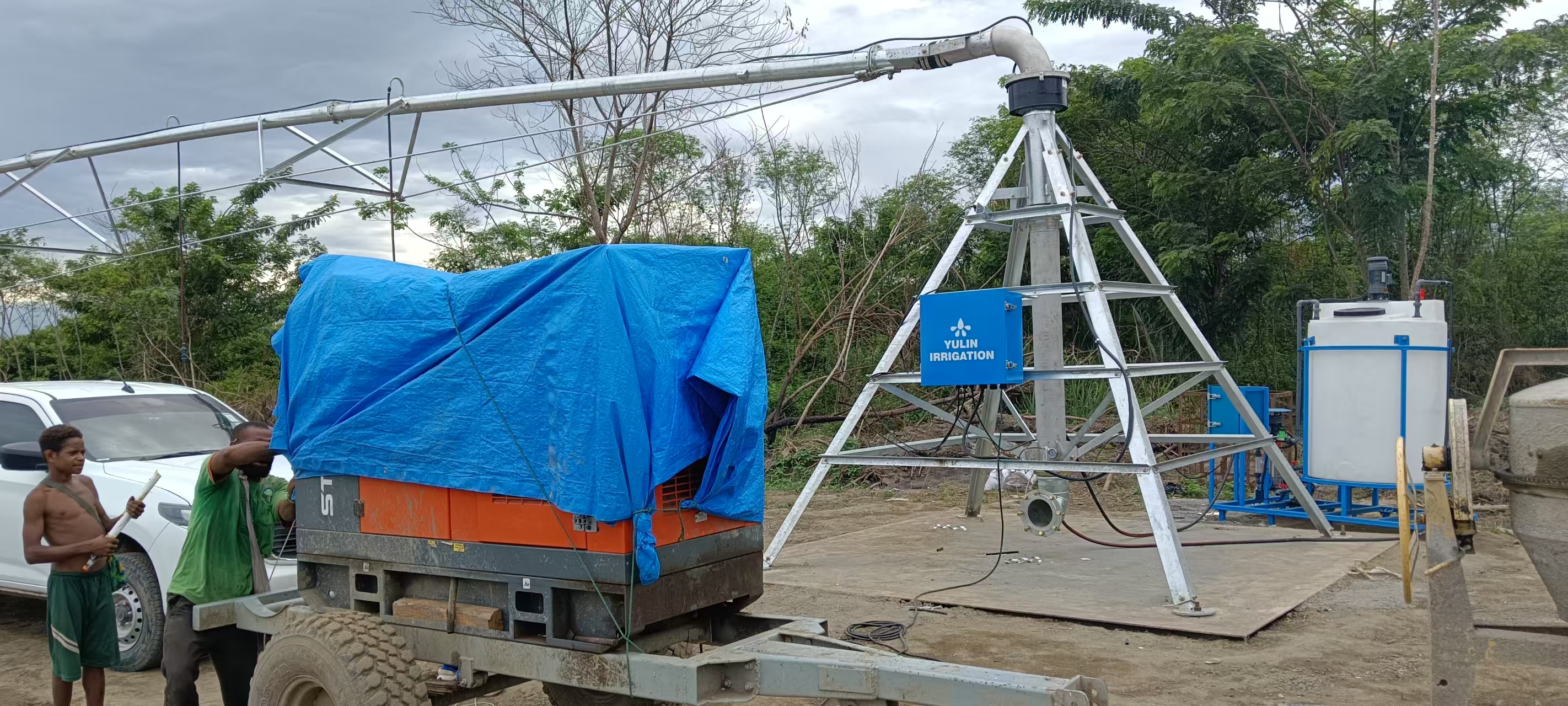
Diesel generator power supply for a pivot on farmland without reliable grid electricity.
Continuous 100-hectare cereal or industrial-crop blocks — 565 m, 100 ha
This is a permanent-infrastructure decision: one circle, one control panel, one power feed. Corn and other tall crops fit under the 3 ± 0.2 m truss clearance, and because every span has its own reversible drive, speed regulation stays per-span along the machine.
Rotational fodder, cereal and vegetable farms — 307.4 m, 30 ha
A farm rotating between fodder crops, cereals and vegetables can keep one 30-hectare machine in service across the whole rotation, since all three crop groups are inside the documented crop range.
Trial blocks, satellite parcels and first machines — 177.6 m, 10 ha
At 10 hectares the machine is small enough for trial and seed-multiplication blocks and large enough to be a genuine production pivot. It is also the size at which towable and linear alternatives from the same product family are worth comparing directly.
Corners and parcels outside the circle, including no-grid fields — JP800 hose reel
A 300 m PE hose with a 19–41 m spray radius and water-turbine drive covers elongated parcels, corner strips and fields with no power supply, without adding a second pivot.
Comparison Table: Five Configurations Side by Side
| Rank & model | Length | Coverage | Pivot / machine type | Material & standard | Best-fit situation | Documented note |
|---|---|---|---|---|---|---|
| 1 — Center Pivot Irrigation System | 565 m span | 100 ha | Fixed DYP center pivot | Q235B metal, GB 13912-2020 | Largest continuous blocks of cereals, fodder and industrial crops | Requires a large contiguous block; corner land stays outside the circle (land usage coefficient ≥ 0.9) |
| 2 — Center Pivot Irrigation System | 395.6 m span | 50 ha | Fixed DYP center pivot | Q235B metal, GB 13912-2020 | Dry-season production where irrigation substitutes for rainfall | Documented project used an end spray gun, 1,000 L fertilizer tank and diesel generator power |
| 3 — Center Pivot Irrigation System | 307.4 m span | 30 ha | Fixed DYP center pivot | Q235B metal, GB 13912-2020 | Rotation farms mixing fodder crops, cereals and vegetables | Same panel, drive and regulator architecture as the larger spans |
| 4 — Center Pivot Irrigation System | 177.6 m span | 10 ha | Fixed DYP center pivot | Q235B metal, GB 13912-2020 | Small center pivot: trial blocks, vegetable and fodder parcels, satellite fields | Smallest irrigated area in the ranking; corner loss is proportionally larger |
| 5 — JP800 | 300 m hose, 90 mm PE pipe | Spray radius 19–41 m | Travelling hose reel irrigation machine (hose reel irrigation system category) | Metal and PE | Corners, elongated parcels and fields without grid power | Water-turbine driven, no electricity required; flow 25–52 T/H; weight 2,180 ± 30 kg |
The table uses only specifications published in the product data. It does not compare prices, because no list prices are published and each configuration is quoted individually against a measured field, a water analysis and a power supply.
FAQ: Compliance, Coverage, Cost, Validation and Lead Time
What material and galvanization standards does the center pivot irrigation system comply with?
The documented material is Q235B metal conforming to GB 13912-2020, and the anti-corrosion coating is applied by hot-dip galvanization as listed in the product data under GB/T 13912-2002. Structural details supporting that specification include tower trolleys on 14.9-24 irrigating tires with hot-dip galvanized discs, a truss-structured sectional water pipeline, and PVC reinforced UV-resistant flexible hoses. In-field water distribution uniformity for centre-pivot and moving lateral machines is defined by ISO 11545:2009. China Yulin Irrigation Equipment Co., Ltd. further states that its irrigation equipment holds CE, ISO9001 and CSA certification and undergoes anti-corrosion and wind-resistance testing for tropical, saline-alkali and high-wind farmland.
How much land can one Yulin irrigation pivot system irrigate?
Four configurations are documented: 177.6 m covering 10 hectares, 307.4 m covering 30 hectares, 395.6 m covering 50 hectares and 565 m covering 100 hectares. All four are Fixed DYP center pivots with electromechanical, reversible drives controlled individually for each span, operating at 380–460 V, with the truss underside 3 ± 0.2 m above the ground and a land usage coefficient inside the irrigated circle of not less than 0.9. Maximum rain intensity is 0.16 mm/min and average drop diameter is not more than 1.1 mm. For coverage beyond the circle, the JP800 hose reel machine adds a 300 m hose with a 90 mm PE pipe.
What drives the cost difference between the five configurations?
No list prices are published, so each configuration is quoted individually; what changes between them is measurable. Span length changes steel tonnage and truss section; every additional span adds a tower with two 14.9-24 tires and an independent electromechanical drive; electrical content scales with tower count, the 11-ring collector ring rated not less than 4×90 A and 7×25 A, and the copper cable core of not less than 4×4 mm² + 7×1.0 mm². Options documented in the product data — an end spray gun, a 1,000 L fertilizer tank, poly pipe for aggressive water, and diesel generator power — extend the delivered scope. Buyers comparing quotations should compare coverage per span and the documented operating envelope, including clearance, rain intensity, pH range and temperature range, rather than headline price alone.
Can a buyer validate a configuration before placing a full order?
The documented service model is specification-based rather than catalogue-based. Yulin provides flexible customized modification solutions according to farm terrain, crop varieties, power supply conditions and personalized irrigation demands, supported by an R&D team of 10 engineers, and welcomes OEM and ODM orders. A buyer can therefore submit a measured field map, a water pH reading and power supply data, and ask for the configuration to be specified against those inputs. Sample, quotation and technical enquiries are handled through yulinirrigation@hotmail.com, +86 158-4249-7638 (phone and WhatsApp), and the full specification set is available in the 2026 YULIN Pivot Catalogue (PDF).
What delivery and installation support follows an order?
China Yulin Irrigation Equipment Co., Ltd. produces about 3,000 units a year from a 64,653 m² facility with approximately 152 staff, and its published supply page lists a capacity of 400 pivot sets per year; the factory sits about two hours by truck from Dalian Port. Approximately 60% of output is exported to Australia, New Zealand, Canada, Mexico, Africa, Central Asia, Russia and Kazakhstan. Overseas, the company provides global localized on-site installation, commissioning and operator training — the same model documented in the Papua New Guinea dry-season project, where Yulin engineers supervised assembly on the client farm. To start a shipment plan for one of the five configurations, send the field map and power and water data to yulinirrigation@hotmail.com or WhatsApp +86 158-4249-7638.
Conclusion: Rank by Coverage, Decide on the Documented Envelope
For large-scale farming, the practical shortlist is four span lengths and one complementary machine. Choose the 565 m configuration when a single contiguous block of 100 hectares has to run as permanent infrastructure. Choose the 395.6 m configuration for a 50-hectare block with dry-season demand, since that is the span with the clearest documented project record, including end gun, fertigation tank and generator power. Choose the 307.4 m configuration for a 30-hectare rotation farm, and the 177.6 m configuration for a 10-hectare production, trial or satellite block. Add the JP800 hose reel machine where corners, elongated parcels or grid-free fields fall outside the circle.
What separates these five from each other is not a slogan but a set of published numbers: coverage in hectares, span length in metres, truss clearance of 3 ± 0.2 m, rain intensity up to 0.16 mm/min, drop diameter up to 1.1 mm, water pH 6–7.5, temperature from −45 to +45 °C, and the Q235B / GB 13912-2020 material specification. Matching those numbers to a measured field is the whole decision.
Next Step: Request a Configuration Quotation and the Catalogue
China Yulin Irrigation Equipment Co., Ltd. (YULIN IRRIGATION), established in 2009, manufactures center pivot, lateral move, towing and hose reel irrigation systems plus irrigation parts at 329-1 of Shunle Street, LvShunKou District, Dalian City, Liaoning Province, China.
Send your field map, water pH and power supply details to yulinirrigation@hotmail.com or WhatsApp +86 158-4249-7638 to request a quotation, samples or technical documentation for the 177.6 m, 307.4 m, 395.6 m or 565 m pivot, or for the JP800 hose reel irrigation machine.
Full specification set: 2026 YULIN Pivot Catalogue (PDF) · Company website: www.cyulin.net
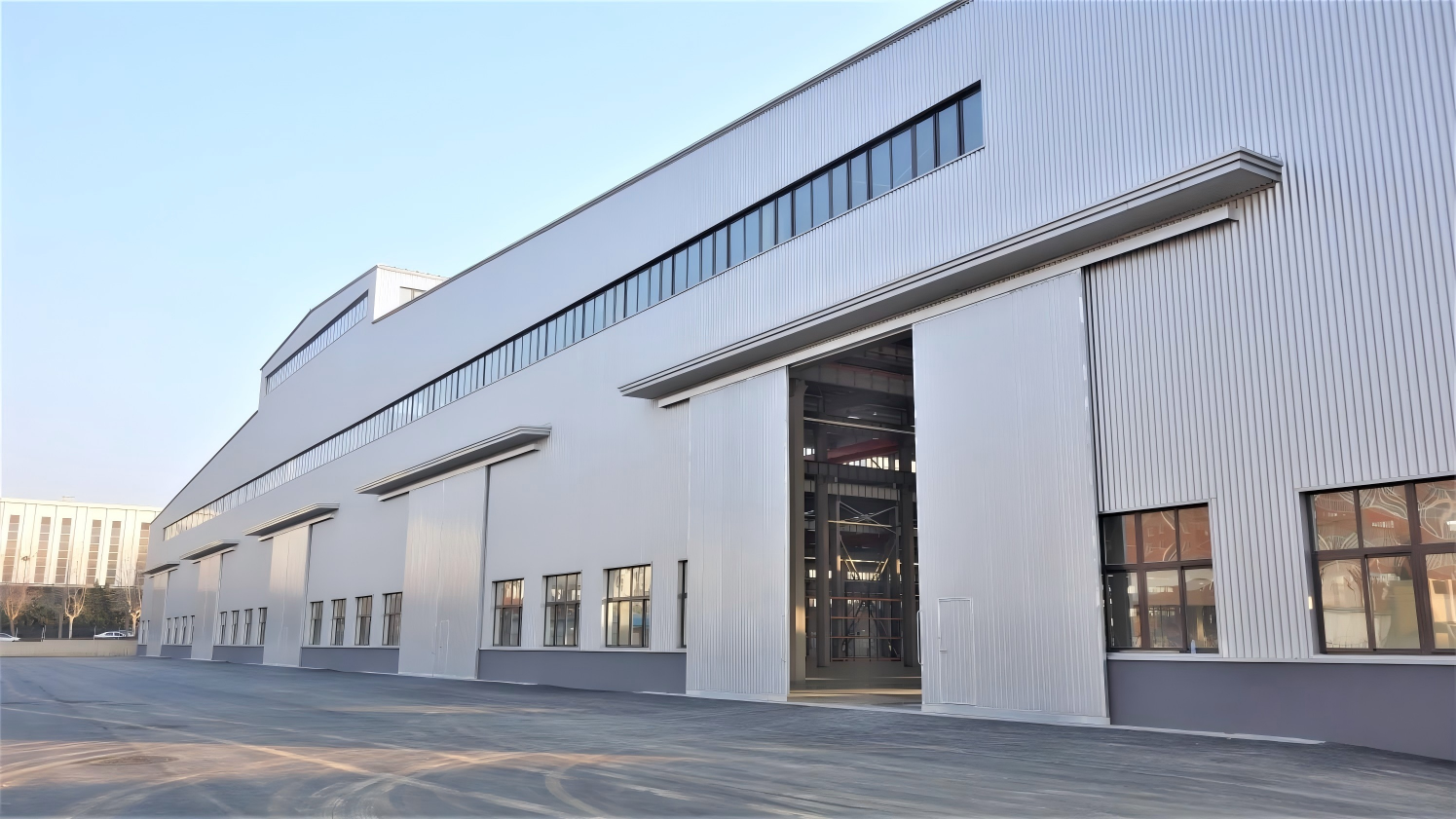
Finished irrigation machine components staged for shipment at the Yulin Irrigation workshop in Dalian, China.
Have Questions or Need More Details?
Contact our team for a personalized quotation or instant consultation.
Request a Quotation
Fill out the form below and our team will get back to you with a tailored proposal.
WhatsApp Direct Chat
Prefer to chat in real-time? Message us on WhatsApp for instant assistance & quick answers.
- Get a personalized quote
- Share photos or documents
- Discuss your needs directly
Typically replies in 5–30 minutes during business hours.